Monday, July 16, 2012

More LTD Stirling Engines You Can Build Without a Machine Shop


I have started working on another collection of Stirling Engine plans that will become the next installment in the series of designs of Stirling Engines you can build without a machine shop.  This will be another series of LTD engines that should be capable of running from the heat of a warm hand.
The first set of LTD designs has become a popular seller.  “Three LTD Engines You Can Build Without a Machine Shop” has been selling very well in the United States, in the United Kingdom, and in Europe.  I have received inquiries asking if my books are available in German, Spanish, and Norwegian.  I also receive occasional requests for an electronic version of all three of my current books.  Publishing eBook versions of these texts is not currently in development, but will likely be happening in the future.

Several have commented on the non-traditional approach to Stirling Engine design used in the first book.  The design variations that were made were all done in order to reduce friction and make a true LTD engine possible without a machine shop.  This new project will create a series of LTD engines that follow in the spirit of the traditional pancake style LTD engine. 
The current outline for the new book has 4 engine designs with a variety of configuration options.  If you include all the configuration variations (large, small, round, or square) there will be 12 complete sets of plans in the new book.

The book will be written with the worldwide audience in mind.  Measurements will be primarily in inches with the metric equivalents shown.  The parts and materials needed for construction will be very affordable and should be available worldwide.  Alternative materials and building techniques will be provided so that builders will have options to choose from when assembling their own engines.

Sunday, March 25, 2012

Eleven Stirling Engine Projects You Can Build

It has been a while since I have posted about the experience of designing Stirling engines and the production of my books.  I want to say that I am very happy with the feedback I have heard so far on the latest book, "Eleven Stirling Engine Projects You Can Build".  There really is nothing else like it that I can see in the market right now.  If you want to see a comprehensive collection of Stirling engine projects including kit-built engines and pop can engines, this is the book you must have.  I hope to dedicate some time in the near future to adding some posts to this blog that talk about each project.  I will give you some of the back stories about how these engines were selected for review, and how the original engines were designed.

There are many resources for free Stirling engine plans available on the Internet.  I got my start in this hobby by building engines from some of those plans.  That is a great way to get started.  The designs I made for this book offer you several advantages over the plans you will find on the Internet.

  1. The pop can engines in this collection are engineered with some advanced thermodynamic principles that are not present in any of the free plans you will find on the Internet.  These design elements make the pop can engines efficient enough to be air cooled.  This is a tremendous advantage when it comes time to show off your work.  You don't need to add ice, and you don't need to add water to get your engine to run.  Just light the candle and spin the flywheel.  The engine will run until the candle is extinguished.
  2. The plans in this collection offer a great amount of detail and the instructions are thoroughly explained.  You will be told how to do perform each construction step.  And you will also learn the important information behind each step and why it is important.  There are multiple pictures for every construction step.  You will see the parts being made with pictures taken at every key phase of construction.  In some cases, you will even find references to videos posted online to help you even more.
  3. The plans in this collection allow you to make the best choice for which engine would be best for you to build.  You can decide if you want to build a kit, or if you want to build a motor from scratch.  You will have the knowledge you need to make an informed decision.
At the present time I have posted 90 videos on YouTube that show Stirling engines running or being built.  That collection of video resources will continue to grow as I have plans for many more informative and instructional videos in the days ahead.

If you want to hear more about the 11 Stirling engine projects in the latest book, subscribe to my blog and you will be notified whenever I add a new post.


Friday, March 18, 2011

Troubleshooting Tips


How to Trouble Shoot a Stirling Engine

When they are working well, Low Temperature Differential (LTD) engines have just enough power to overcome their own friction.  It is very common to experience difficulty when trying to get a new engine to work for the first time.  If you are having trouble getting your Stirling engine to run, here are some troubleshooting tips.

Temperature Differential

Do you have sufficient temperature differential?  You do not need to overheat your engine to get it to run.  You need both hot and cold.  Your heat source may be a candle or a cup of hot water, depending on your engine design.  Not every candle is hot enough.  If it does not harm your engine, try a candle with a larger flame, or perhaps more than one candle.   An alcohol lamp may provide even more heat than a candle.  Never heat your engine above the operating temperature it was designed for.

Keep the cool side as cool as possible.  This usually means adding ice.  Don’t let the ice interfere with the operation of the engine.  And never let water get inside the engine.  If ice melts and the water runs in through the pressure chamber gland, you will have to disassemble your engine and dry it out.

The key to the temperature differential is the DIFFERENCE in temperature between the warm side and the cold side.

Engine Rotation

I have seen some people try to rotate their engine in the wrong direction!  The rotation direction is determined by the phase angle between the displacer and the drive mechanism.  In most small Stirling motors the section of the crankshaft with the drive mechanism is following 90 degrees behind the rotation of the displacer piston.  So, when the displacer piston reaches the top, the drive piston is half way up.  When the displacer piston reaches the bottom, the drive piston is half way down.

If your displacer is not moving far enough, it may not be creating enough “displacement” to move the air inside your engine.

Pressure Leaks

A teeny tiny pressure leak is usually a good thing.  I have made several engines with air tight pressure chambers, and they actually need to have vents added to them so that the pressures can occasionally be equalized.  However, it is very easy to get too much air leaking out.  Since there is barely enough power to move the flywheel, it doesn’t take much of a leak to stop it.

One place pressure often leaks is around the drive piston (if you have one).  If you use a diaphragm drive, leaking is not a problem here.  Sometimes a little oil will help to lubricate a loose fitting piston while also slowing a leak. 

If you are using a diaphragm drive, it must be set up so that it is not too loose.  If the diaphragm is too loose, it is the same as a leak.  All your pressure changes will be consumed in moving the loose fabric of the diaphragm, and the motion will not go to your flywheel.  The diaphragm has to be set just right, so that all the slack is gone at each end of the stroke.  But do not make it too tight, or the motor will have to fight against the fabric in order to rotate.

Friction

As a general rule, if it makes noise, it is making friction.

If the displacer is hitting, touching, or rubbing the inside of the pressure chamber, that is increasing your friction.  Minimize this the best that you can.

If your displacer is coming to rest against a flat surface, it is increasing the “pull off” friction by creating a vacuum between the two flat surfaces.  This is one reason why you want your displacer to stop 1/16” to 1/8” before touching a flat surface.

If your displacer does not have enough clearance for air to pass around it, this is increasing friction.

Every place where two moving parts touch has friction.  You cannot eliminate friction, but you must minimize the friction at every point where moving parts come together.  If you can create a design with fewer moving parts, you will also have fewer friction points.

Check the displacer motion and make sure it is not rubbing the inside of the engine.  Make sure it is not hitting the top or the bottom.

Check the motion of the displacer shaft through the gland.  This is a common trouble spot for both friction and leaking.

Check both ends of the connection between the displacer and the crank shaft.  The direction of push/pull must always be perpendicular to the axis of the drive shaft.  If the connecting rods are pushing at an angle other than 90 degrees, this will cause binding.  Install keepers in necessary to maintain the angle of the connecting rod.

Does your crankshaft and flywheel turn freely?  If you disconnect the displacer and the drive mechanism and spin the flywheel, how long will it coast?  The pop can motor on my desk right now will coast for 15 seconds with a flywheel made from two CDs.  If yours spins for less than 5 seconds, you have a serious friction problem.

Check the connecting rod between the crank shaft and the drive mechanism.  This connecting rod must also always push and pull at 90 degrees to the crank shaft axis.  If this is pushing to the side, it will cause friction and bind.  You may need to install a keeper of some sort to get it to stay at the correct angle.

If you have a piston, make sure it does not bind.  It must fit loose enough to fall through the cylinder under its own weight when there is no air pressure holding it up.  And it must fit tight enough that it will not drop (or it will not drop quickly) when there is air pressure to cause resistance.  If it is a tight fit, you may need to make it looser by polishing.  If it is a loose fit, you may want to try oiling it.

Summary

Check everything thoroughly, but modify only one thing at a time.  If your modification improves performance, keep it.  If your modification makes things worse, or makes no change, set it back the way it was.  If you change too many things at the same time and it degrades your performance, you won’t know which change caused the problem.

It is very normal and natural for these engines to require some tweaking and tuning to get them “in the zone”.  Once you have them tuned up, they will run for a long time.  Remember: Low Temperature Differential (LTD) engines have just enough power to overcome their own friction.  You must pay great attention to detail to maximize power (by managing leaks and temperature differential) and minimize friction to make these motors run well.

Monday, February 28, 2011

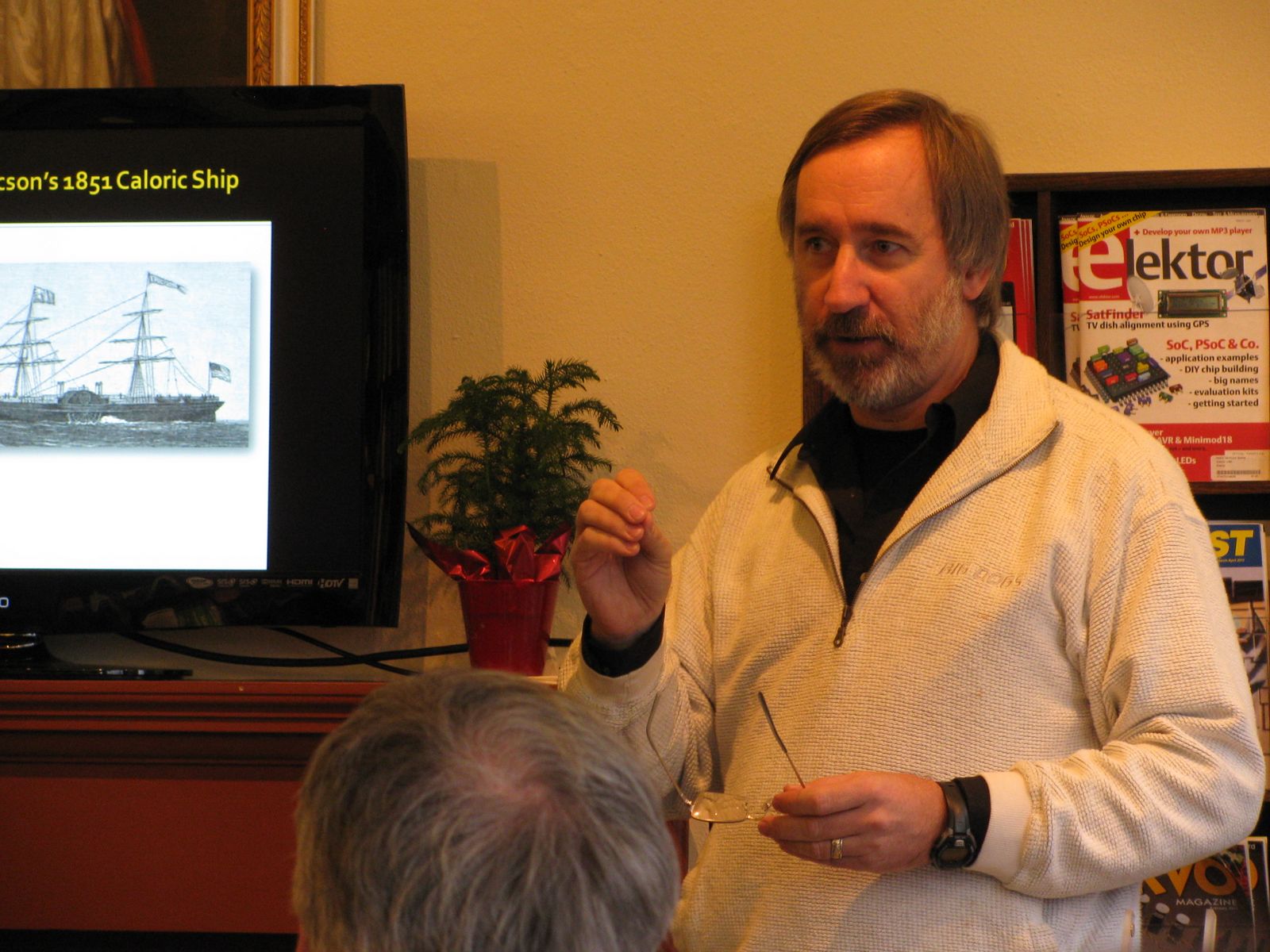
I had the opportunity recently to speak and present a demonstration of my Stirling engines at Ada's Technical Bookstore in Seattle.  It is a wonderful, cozy little store. There were about 25 people there for the presentation.  We met some wonderful folks and had a great time chatting about the marvelous little Stirling engine.My engines were very well behaved and put on a good show for the folks.

Saturday, February 12, 2011

Small Parts Photo Studio

The working laboratory of most evil genius inventors can be a messy place.  Mine is no exception.  I am in the process of designing, building, and documenting the construction of several Stirling Engines and I needed a way to photograph the small parts as they were created.  I also needed a way to photograph the completed Stirling Engines.

I was tempted to buy the Portable Photo Studio sold by ThinkGeek.com for $50 (http://www.thinkgeek.com/electronics/cameras-photography/a205/). But the dimensions of that setup are not tall enough for some of my completed projects.  So I created a similar setup on my own for about $30.

The backdrop is a display board like the kind kids use for science fair displays.  Cardboard versions are about $5.  This one is made from paper covered foam core poster board and sells for about $15.  The floor of the studio is made from another piece of foam core poster board.  One side of the floor board is white, the other is black.  Some small parts are light in color and need a dark background for best results.  I simply turn the bottom piece over and use the black side when I need the dark background.

I already had two movable lights.  One contains an old incandescent bulb and the other has a bright energy saving bulb. That provides a little light balance for the pictures, which I will reduce to B&W anyway for publication.  I use a 10MP snapshot camera with a flash and I am getting very good results. The second image here is an un-edited photo taken in the homemade studio.

Saturday, December 11, 2010

I Am Furlough Daze!


Every great blues musician has a cool moniker.  I may not be a great blues musician, but I have found my moniker.  I am Furlough Daze!  I used my new personality to record a collection of 10 blues jams for a charity fundraiser at work.  It was one of the quickest projects I have put together, and it is also one of my personal favorites.  It feels a little strange when you favorite instrumental blues CD is your own work.  But I do enjoy listening to this one a lot.

I got started on this project by entering the King of the Blues guitar contest at Guitar Center.  That got me playing many of these songs.  The band you hear on the CD is actually the contest backing tracks from Guitar Center.  (I sent them an email and they told me I could use them for the CD.)  That made the project move very quickly as I didn't have to create the whole band, just the lead guitar part.

I used three different guitars in the recording, and my Line 6 Amp Simulator.  It gives a nice variety of textures with some gentle acoustic guitar, some classic blues crunch, and some over-the-top 80's metal sounds.

The 10 tracks on this CD are:
Slow Down Blues
Stone Blues
Slow Blues
110 In The Shade
Talkin' My Baby Down
Laid Down Blues
A Minor Affair
Still In Love
Little Girl Shuffle
East Coast Blues

You can download these for free by visiting http://soundclick.com/jimlarsen.  Or if you can find me on the planet you can get a CD from me!

Stay Cool!
Furlough Daze

Thursday, December 9, 2010

A Top Seller on the Subject of Stirling Engines

For the past several weeks my book has been the top selling Stirling Engine book at Amazon.com!  This is based on a search for "Stirling Engine" at the website http://www.salesrankexpress.com/.  The search results are listed in the order of Best Selling as determined by Amazon.com.  This is exciting news!  The book was first released on June 20, 2010.  Sales have grown slowly and steadily each month.  I am seeing in increase in both retail sales through Amazon and also through the wholesale sales channels.  I have now shipped 50 autographed copies to Camden Miniature Steam Services in the United Kingdom.  It sounds like they are selling very well in England.  There are days that I run the battery down on my smartphone because I am checking the sales reports so often.

Print On Demand (POD) publishing is working great for me.  The profit margin is nice, and the service is very good.  I had no idea what to expect when I started this project.  I was going to be happy just knowing I had a book published.  I didn't even try to set a goal for how many copies would sell or how much they would go for.  The income is not enough to let me quit my day job.  But it will be enough to make saving the money in a bank account lots of fun.

As an author I am always evaluating new ideas for a next book.  I wonder if having one profitable title on Amazon qualifies me to write about the process and share the lessons I have learned?  Here are some of the factors that I think are contributing to the success of this project.

  1. It really is a good book.  It meets the goals that it says it will do.  It is well written and easy to understand.  Is is illustrated sufficiently well to add value to the reader.  In short, it is a good product and it is worth the asking price.
  2. It is in a market that is not flooded with surplus titles.  The advice I received was solid.  I was told that a good book on this topic would sell well.  There is really nothing else like it.  It is a small market, but it is standing out because it meets a need for many people.
  3. YouTube helps!  I have about 20 videos of my engines on YouTube.  Every video has a caption that promotes the website or the book.  I receive between 200 and 400 views a day. That adds up to between 6,000 and 12,000 views per month.  I placed a hyperlink in the text descriptions of each video that points to my website.  I accidentally discovered that there are websites all over the world that clone videos from YouTube, and they take the descriptive text with it when they clone it on their own website.  This means that instead of having just 20 hyperlinks to my webpage from YouTube, I have hundreds of links to my site showing up all across the web, in many countries and languages.  This raises my status in search engines and makes my website show up better in search results.
  4. I have a nice looking website that draws steady traffic.  I am receiving about 2000 visits per month at the website now.  I am giving away free Stirling Engine plans to help draw traffic. The book is promoted on the landing page.  I have not had many sales from my website.  (Which is unfortunate because I make more money on those!)  But I know people like to buy from sites they trust, so I let people know they can order it at Amazon.
It has been fun to see that my URL and even my name are now searched for in Google. I can't say I get fan mail, but I do occasionally get some nice comments on you YouTube videos.

I am including a picture here of the search results today at Sales Rank Express.You may not be able to read the details, but that fuzzy blue image at the top of the list is my book, Three LTD Stirling Engines You Can Build Without a Machine Shop!  You can click on the picture to see a larger view.

If you don't have your copy yet, order one today! :-)